
What this blog includes
- What rumination honestly is, in the research sense
- How it differs from everyday overthinking, worry, and decision paralysis
- A side-by-side table so you can tell which pattern yours is
- What actually works for each one, and when to see a therapist
If you have Googled “rumination vs overthinking” at 11.47 pm, you are probably trying to name something that feels bigger than a bad habit. The word “overthinking” is everywhere; the word “rumination” sounds clinical. The honest answer is that they overlap, but they are not the same, and the difference changes what helps you tonight.
We will keep this plain. GoodLives is trusted by 500K+ people across the globe, and this piece is written for the person noticing the same loop on repeat without a name for it yet.
What rumination actually means
Rumination is a specific pattern of thinking. It looks backward, it repeats, and it is often self-critical. The usual phrases are “why did I say that”, “I always do this”, “I am such a”. It does not reach a decision, it does not change what happened, and it does not stop on its own.
The psychologist Susan Nolen-Hoeksema spent twenty years studying this one pattern. Her Response Styles Theory found that people who ruminate when they feel low have a two-to-four times higher risk of a major depressive episode within a year, compared with people who distract or problem-solve. The style of thinking, not the content, feeds depression.
That is why rumination has its own name in research. It is not generic worry and it is not reflection. It is a loop that returns to the same past moment, usually with blame.
In short: rumination is backward-looking repetitive thinking, often self-critical, and it keeps low mood going longer than it needs to.
What overthinking means in everyday use
Overthinking is a wider word. In common speech it covers rumination, worry, decision paralysis and over-analysis, all under the same umbrella. You might say you are overthinking a reply, a job offer, a message from your mother and a comment from last week, and all four are different patterns under the same roof.
So when someone says “I overthink everything”, three different things are usually happening. The first is rumination, replaying the past. The second is worry, rehearsing the future with “what if the appraisal goes badly”. The third is decision-overthinking, stalling on a present choice until the choice gets harder.
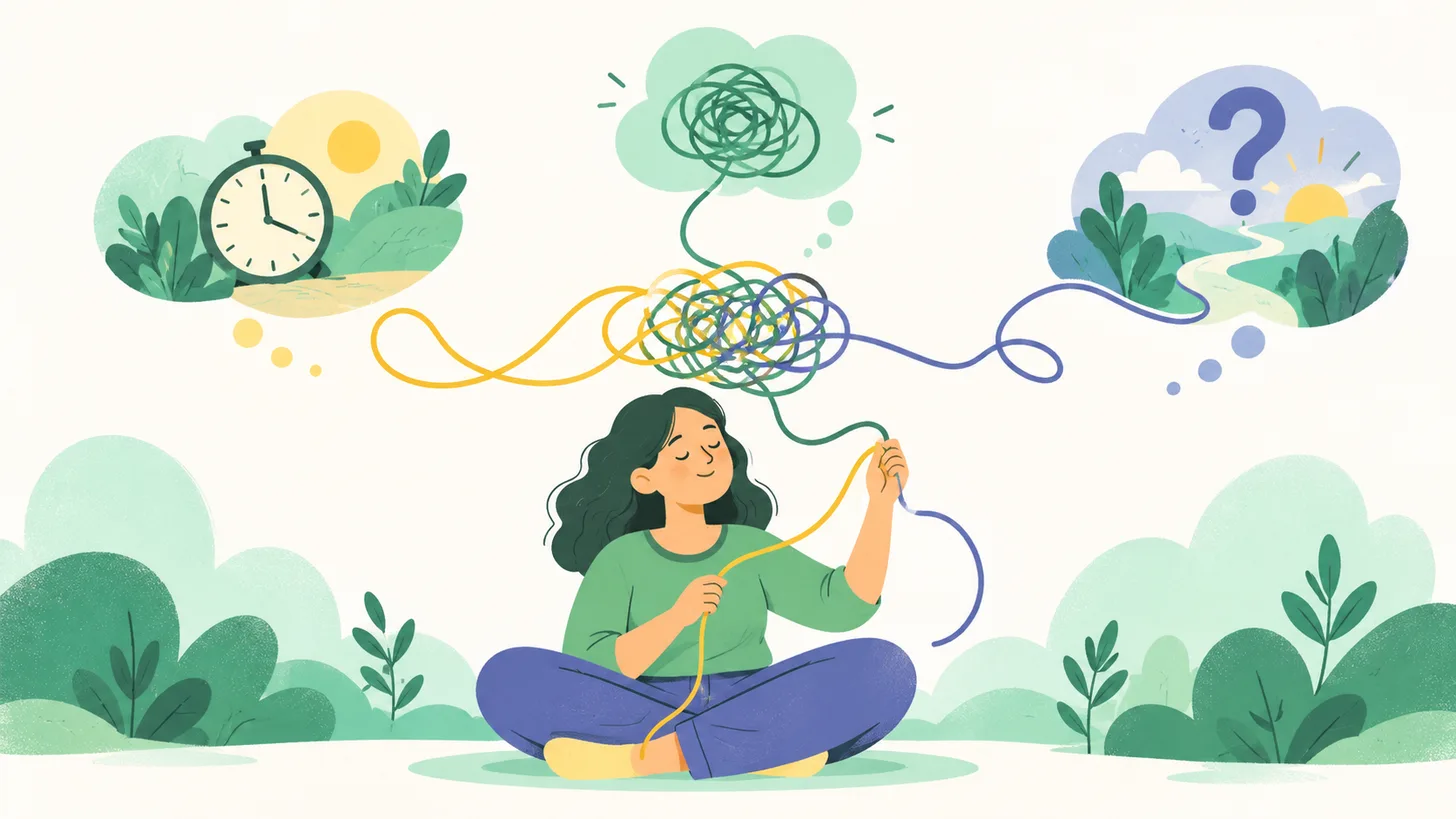
Each of these responds to different tools, which is why “just stop overthinking” has never worked for anyone. You cannot use the same wrench for all three nuts.
In short: overthinking is a popular umbrella word; underneath it sit three different patterns that need three different responses.
Rumination vs worry vs decision-overthinking, side by side
Here is the honest comparison. If you recognise your loop in one column, that is a useful clue.
| Feature | Rumination | Worry | Decision-overthinking |
|---|---|---|---|
| Time direction | Past | Future | Present |
| Common thought | “Why did I?” | “What if?” | “Which option?” |
| Common emotion | Sadness, shame, regret | Fear, dread | Pressure, pre-regret |
| Shows up most in | Depression, grief | Generalised anxiety | Choice-heavy weeks |
| Research base | Nolen-Hoeksema, Wells | Borkovec | Schwartz |
| Tools that help | Behavioural activation, MCT, self-compassion | Scheduled worry time, CBT | 10-10-10, 70% rule, satisficing |
You might find your loop uses two columns at once. The late-night replay of an exam that is already over (rumination), that opens into “what if I never get into IIM” (worry), that then stalls your reply to a recruiter at 11 pm (decision-overthinking), is the same evening wearing three costumes.
In short: name the costume first. Each one has its own tool.
How to tell which one yours is
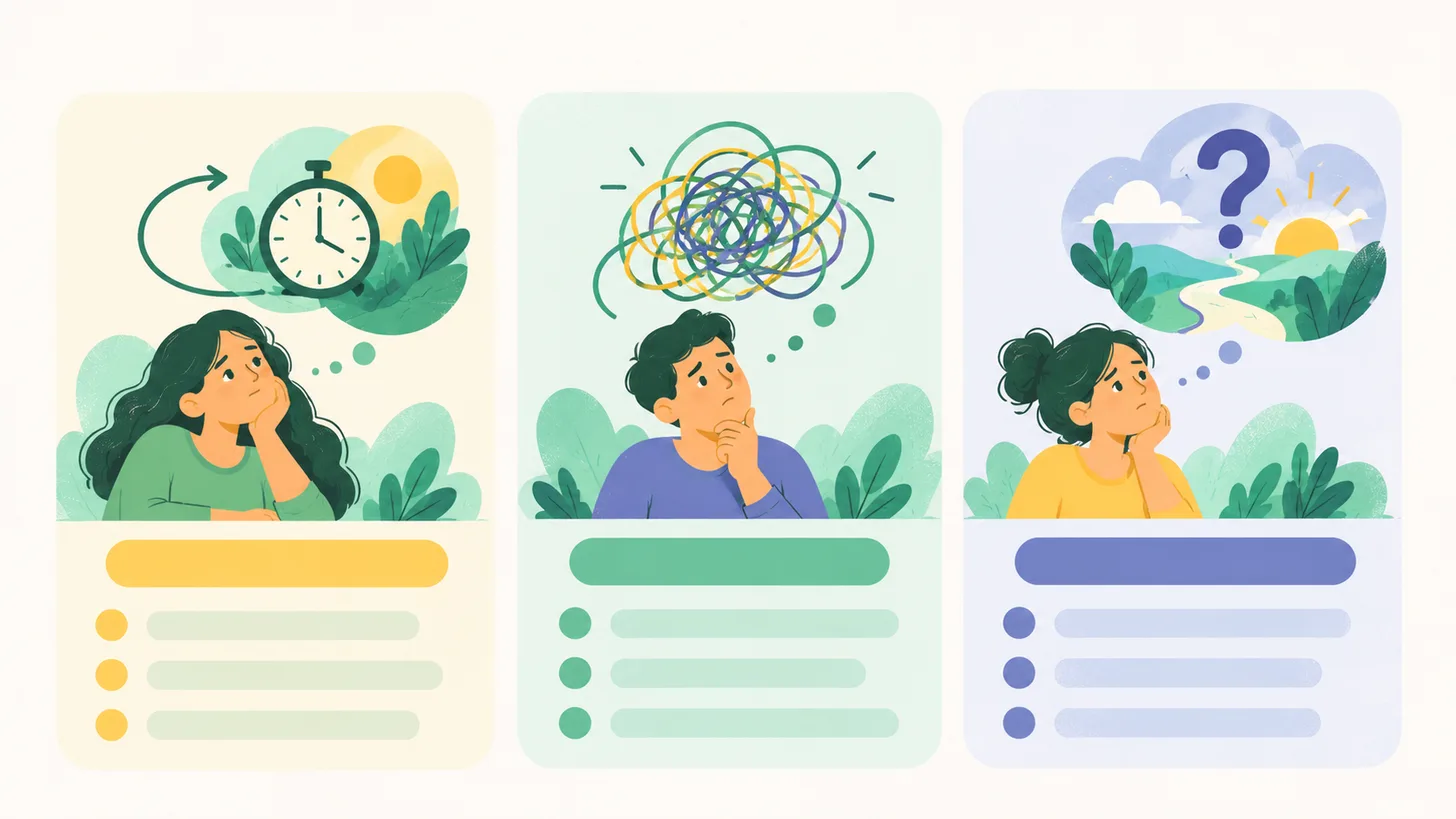
A simple test, written for your phone screen. Ask three questions about the loop you are in right now.
Where is the thought pointing? If behind you, probably rumination. If in front, probably worry. If on a decision in your lap, probably decision-overthinking.
How does the thought end? Rumination ends in a feeling about you. Worry ends in a feeling about the thing. Decision-overthinking ends in a stalled option.
What would relief look like? Rumination relief is letting yourself off the hook. Worry relief is a plan. Decision relief is a smaller version of the choice.
You have probably been using the wrong tool for the wrong loop, which is why nothing has worked yet. That is not a willpower failure, it is a labelling problem.
In short: ask where the thought points, how it ends, and what relief would look like. The answer names the pattern.
What helps rumination specifically
Rumination is the loop that most needs replacement, not reasoning. You cannot think your way out of a thinking pattern.
Behavioural activation means doing before deciding — a 10-minute walk, one tiny chore, one message to a friend. Depression research is clear on this: action usually precedes motivation, not the other way around. The movement interrupts the loop before the loop finishes its sentence.
Metacognitive therapy (MCT). Adrian Wells’s work shows that rumination is kept alive by beliefs about thinking itself, beliefs like “if I keep going over it, I’ll figure it out”. His randomised trials teach a skill called detached mindfulness: watching a thought arrive and pass without engaging with it, the way you watch a bus you are not catching.
Self-compassion is counter-intuitive here. People assume self-criticism keeps us sharp. In studies, self-compassion, spoken to yourself the way you would speak to a friend, reduces rumination even when the facts of the day do not change. The harsh inner voice is the fuel, not the brake.
If you want, take one slow minute with this before you read on.
Catch the thought
What thought is weighing on you right now? Write it down just as it sounds in your head.
Name the trap
Does your thought fall into one of these common patterns? Pick any that fit. This part is optional.
Look again
Use these as nudges, not rules. Then write one line back to yourself.
Your reframe
Thoughts are not facts. You just practised stepping back.
This stays on your device. Nothing is saved or sent.
A therapist can help you see which of your rumination loops are a mood pattern, which are grief, and which are a trauma response. Self-help gives you the tools; therapy helps you pick the right one for the loop you are in this month.
In short: rumination responds to doing, labelling, and kinder self-talk, not more thinking.
What helps future-worry
Worry is a different animal. Scheduled worry time, tested by psychologist Thomas Borkovec, sets aside a fixed 20 or 30 minutes a day, same time and place, to worry on purpose. Outside the window, worries get written on a notepad and told to wait. Within two weeks there is a measurable drop in daily worry.
Pair that with sorting controllables from uncontrollables: for every worry, ask what you can act on in the next 24 hours and do the smallest version. If there is nothing to act on, the worry gets the notepad. CBT adds a third tool, asking a worry what the evidence is, what else could be true, and what the actual probability is. For a deeper walk-through, our post on how CBT helps with social anxiety sits alongside this one.
In short: worry responds to scheduling, sorting, and testing, not to reassurance.
What helps decision-overthinking
Decision-overthinking is the one most people mislabel. It is not anxiety and it is not depression; it is a choice that outgrew its container.
The 10-10-10 rule asks how you will feel about this choice in 10 minutes, 10 months and 10 years; most “big” choices shrink in the 10-month lens. The 70% rule says decide once you have about 70% of the information, because waiting for 100% usually costs you the choice itself. Satisficing, from Barry Schwartz’s work on the paradox of choice, is the finding that people who try to pick the best option are more anxious and less satisfied than people who pick a good-enough one.
Time-box small decisions. Three minutes for lunch, ten minutes for a reply, one evening for a weekend plan. The box forces the decision; it does not have to be the best one.
In short: decision-overthinking responds to shorter clocks and lower bars, not more analysis.
The India-specific layer: chintan vs rumination
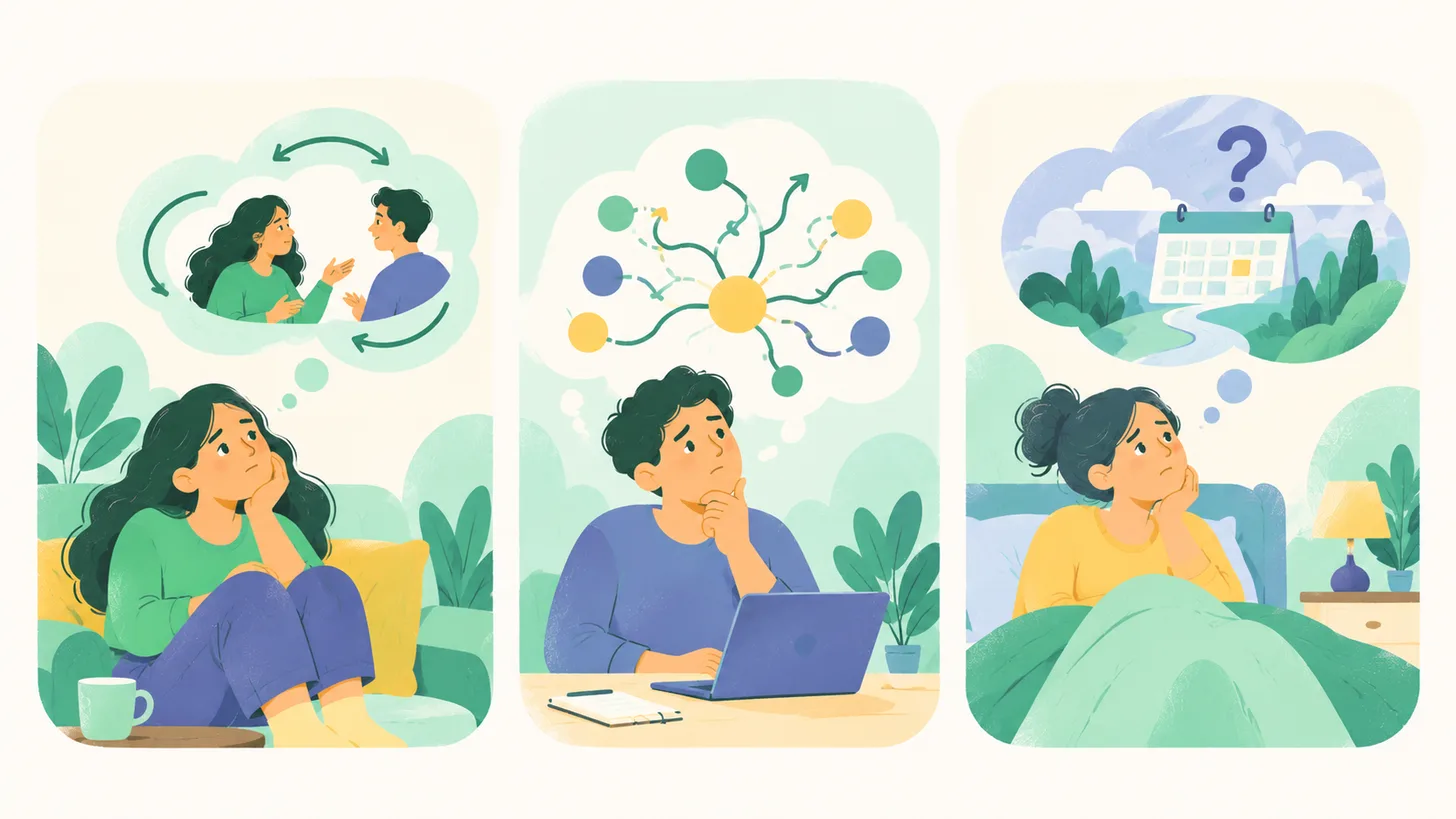
There is a cultural layer here worth naming. In Indian households, reflection — chintan — is a respected practice. A quiet evening of thinking about your day, your choices, your relationships is treated as mature.
The trap is that chintan and rumination can look identical from the outside. Both are a quiet person, thinking. The difference is on the inside. Chintan ends with a shift, a learning, a decision. Rumination ends with the same sentence it started with, usually a harsher version.
A rough test: if your reflection has not moved in 20 minutes, it is probably not chintan any more. The “what will people say” layer can turn a reflective evening into a replay of every social moment of the week, which is rumination with a cultural accent. If this restless unease has a Hindi word in your head, our note on anxiety meaning in Hindi sits next to this one.
In short: reflection moves, rumination repeats. The test is whether you leave the thought in a different place from where you found it.
When overthinking has become a disorder
Most overthinking is a habit of a tired brain. Sometimes it has crossed into something that needs clinical care. A rough rule: see a therapist when four or more of these are true for more than six months.
- The loop is daily and you cannot switch it off even in sleep
- Physical symptoms are showing up: headaches, GI upset, muscle tension, chest tightness
- You are using alcohol, cannabis or sleep medication to quieten the mind
- Decisions are stuck; small ones take hours, big ones months
- The loop has a theme (contamination, harm, “did I lock the door”) that you check over and over
- You feel low or empty for most of the day, most days
Rumination is a core feature of major depression. Worry is a core feature of generalised anxiety. Checking is a core feature of OCD. Each is treated differently, which is why the label matters.
Not every overthinker needs therapy. Some of this is a season you walk through with better sleep, one honest conversation and a worry window. But a six-month daily loop with sleep, body or substance costs is a medical conversation, not a willpower project. Our longer depression guide for India and the companion anxiety guide each walk through the full picture.
In short: label first, pattern second, professional third if the loop is daily, long and costly.
FAQ
What is the difference between rumination and overthinking?
Is rumination worse than overthinking?
How do I stop ruminating about the past?
Is overthinking the same as anxiety?
What is detached mindfulness in metacognitive therapy?
Why do I overthink small decisions?
Is chintan the same as rumination?
This post is for information only and is not a substitute for professional care. If you are struggling, please speak to a qualified mental health professional.




Share your thoughts